News|Articles|June 10, 2026
Dr. Oz at HFMA 2026: Fraud, Medicaid work requirements, prior authorization and AI
Author(s)Ron Southwick
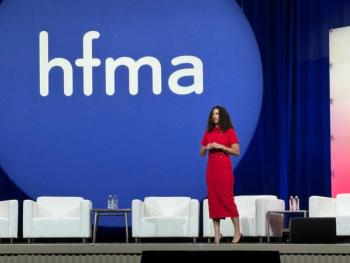
Mehmet Oz, administrator of the Centers for Medicare & Medicaid Services, outlined top priorities during an appearance at the Healthcare Financial Management Association conference.
Advertisement
National Harbor, Md. - Dr.
Oz, the administrator of the Centers for Medicare & Medicaid Services, spoke at the Healthcare Financial Management Association’s annual conference Tuesday afternoon.
During a speech that lasted just over half an hour, Oz cited the Trump administration’s push to eliminate waste, fraud, and abuse. He said that’s a big piece of the strategy to reduce healthcare costs and ensure the long-term viability of Medicare.
He also talked about new Medicaid work requirements, tackling the prior authorization process, and the potential he sees in AI.
Oz said that he wants to protect Medicare and Medicaid, which he said are “spectacular programs.”
“These programs work if they're protected,” Oz said.
Oz also told the audience of healthcare leaders that he’s willing to spend money in healthcare, in the right areas.
“I'm not allergic to spending the money,” Oz said. “I want to make sure, like you, we spend it to get value. That builds confidence. It creates a much more affordable world for our next generation to live in and grow up in.”
Still, healthcare leaders at the HFMA conference have talked extensively about the fallout of the HR 1 federal tax and policy package, which President Trump signed last year.
Analysts project that
Targeting waste
The Trump administration says Medicare’s hospital insurance trust fund will be unable to pay full benefits in 2033,
“Topic number one, you've been reading about and hearing about it, is to crush fraud, waste, and abuse,” Oz said.
“If we just did it for Medicare, you just took the fraud out of Medicare, you would double the life expectancy on the Medicare trust fund,” Oz said.
Oz pointed to the prevalence of fraud and said that much of the problem stems from the expansion of programs during the COVID-19 pandemic.
“We brought a lot of people into the health ecosystem who never thought of defrauding healthcare before, but now that they know it's possible, they're loving it,” Oz said.
Critics have said the efforts to go after fraud
Medicaid work requirements
Oz also sold the value of new rules requiring Medicaid recipients to show they are working.
The Trump administration last week
“You were put here to do things,” Oz said at the HFMA conference. “We don't want folks tolerating, accepting poverty. We want them in prosperity, working and moving up through the ACAs into traditional commercial insurance, and ultimately one day into Medicare. That's how the system is supposed to work.”
Most Medicaid recipients are working or pursuing an education, with 53% holding jobs and 9% in school, according to
Since the release of the rules, critics have expressed concerns about how the rules will be implemented. Some patient advocates worry that Medicaid recipients in early stages of diseases, including cancer, may be required to work to keep their benefits,
Between 3 million and 7 million could lose Medicaid coverage due to new work requirements, according to a
Another 2 million to 3.1 million will lose coverage due to their eligibility being checked more frequently, the report states. Under new Medicaid rules, beneficiaries will have to prove eligibility twice a year, as opposed to just doing it once a year.
Prior authorization
Oz said that he’s optimistic about changes in
“The American people hate it. The doctors definitely hate it. As a clinician, I'll tell you, it was not fun for me to get second-guessed on what I thought were pretty straightforward clinical decisions, but guess who else doesn't like it? The insurance companies. They have to do it because it reduces cost 20% but they don't like doing it the way they're doing it now,” Oz said.
Oz said that solutions to reduce the pain of prior authorization include reducing the number of procedures requiring pre-approval, as well as better technology to speed the process. He said insurers are showing willingness to reform the process.
“We believe working with these big insurance companies that we can actually get our arms around this,” Oz said.
Oz also said providers aren’t sharing some information with insurers, and he said he’s working with hospital groups to improve the speed of information.
Hospital leaders, including some at the HFMA conference, say they are skeptical they’ll see improvements in prior authorization without more uniform standards and tougher rules from the government to speed up reviews and crack down on unnecessary denials.
AI and technology
He pointed to CMS devising a model to pay technology companies for coming up with better apps.
“Now we're up to almost 800 tech companies who have all signed a pledge that they will work together to create this digital transformation,” Oz said. “It includes using AI as a tool if patients desire it. It includes actual apps that will help with disease management, so if you reduce the blood pressure of the patient, you'll get paid money.”
Focus on nutrition
Oz talked about the need to reduce obesity, noting that 43% of Americans are clinically obese, more than twice the obesity rate in Europe.
He touted the U.S. Department of Health & Human Services’
“We now have over 50 medical schools who have pledged 40 hours of nutrition education,” Oz said.
Advertisement
Related Content
Advertisement









































Advertisement
Advertisement
Trending on Chief Healthcare Executive
1
Corewell Health CEO Tina Freese Decker on making a merger successful
2
Ascension’s acquisition of AMSURG shows shift to ambulatory care
3
Dr. Oz at HFMA 2026: Fraud, Medicaid work requirements, prior authorization and AI
4
Multicare's James Lee on tough choices and new opportunities
5